Surface Recombination
The surface also plays an important role in recombination. Typically the surfaces complicate the measurement of the bulk lifetime. Recombination at the surfaces is typically described by a surface lifetime τs, which includes the fundamental decay mode but ignores higher decay modes. τs is a function of the surface recombination velocities S1 and S2, the cell width W and the minority carrier diffusivity D. The precise solution is quite complicated but approximate solutions exist for special cases and are sufficiently accurate for most purposes [Sproul1994].
The simplified formulas given below can be used for transient measurements when the effective lifetime is much greater than the transient surface lifetime (). The more exact expression [Luke1987] [Brody2001]in transient measurements that works in all cases is:
For quasi-steady-state measurements, the formulas are accurate if .
There is a list of approximate solutions for several important cases below:
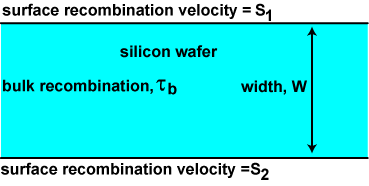
Silicon wafer with a thickness of W
The surfaces are identical so S = S1 = S2.
One surface is perfectly passivated so S2 = 0.
Both surfaces are perfectly passivated so S1 = S2 = 0.
Both surface have high recombination so S1 and S2 are large.
One surface has a high recombination and the other has a low recombination so S1 = 0 and S2 = ∞
Effective Lifetime
Section titled “Effective Lifetime”The combination of the effects of surface and bulk recombination give the effective lifetime of carriers τeff within a sample.
For many measurements, it is possible to reduce surface recombination of the surfaces to a low enough value so that τb ≫ τ eff. Alternatively, if τb is sufficiently high the lifetime measurement is completely dominated by the surfaces and τs ≫ τeff. An accurate measurement of surface recombination is then possible.
References
Section titled “References”- A.B. Sproul, “Dimensionless solution of the equation describing the effect of surface recombination on carrier decay in semiconductors,” Journal of Applied Physics, vol. 76, pp. 2851-2854, 1994. https://doi.org/10.1063/1.357521
- K. Luke and L.-J. Cheng, “Analysis of the interaction of a laser pulse with a silicon wafer: Determination of bulk lifetime and surface recombination velocity,” Journal of Applied Physics, vol. 61, pp. 2282-2293, 1987. https://doi.org/10.1063/1.337938
- J. Brody and A. Rohatgi, “Analytical approximation of effective surface recombination velocity of dielectric-passivated p-type silicon,” Solid-State Electronics, vol. 45, no. 9, pp. 1549 - 1557, 2001. https://doi.org/10.1016/S0038-1101(01)00169-1