Characteristic Resistance
The characteristic resistance of a solar cell is the cell's output resistance at its maximum power point. If the resistance of the load is equal to the characteristic resistance of the solar cell, then the maximum power is transferred to the load, and the solar cell operates at its maximum power point. It is a useful parameter in solar cell analysis, particularly when examining the impact of parasitic loss mechanisms. The characteristic resistance is shown in the figure below.
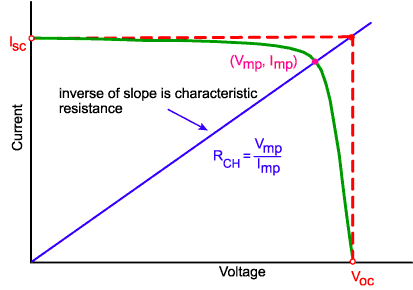
The characteristic resistance of a solar cell is the inverse of the slope of the line, shown in the figure above as VMP divided by IMP [Green1982]. For most cells, RCH can be approximated by VOC divided by ISC:
RCH is in Ω (ohms) when using IMP or ISC as is typical in a module or full cell area. When using the current density (JMP or JSC) then the units of RCH are Ωcm² (ohm cm²)
The characteristic resistance is useful because it puts series and shunt resistance in context. For example, commercial silicon solar cells are very high current and low voltage devices. A 156 mm (6 inch) square solar cell has a current of 9 or 10 amps and a maximum power point voltage of 0.6 volts giving a characteristic resistance, RCH, of 0.067 Ω. A 72 cell module from the same cells has RCH = 4 to 5 ohm. A lead resistance of 30 milliohms has a negligible effect on a full module but has a catastrophic effect on a single cell coupon.
Series Resistance and Power Loss
Section titled “Series Resistance and Power Loss”As long as the power loss is reasonable (< 20%), the characteristic resistance also allows for a conversion between the fractional power loss and series resistance in Ω or Ω cm².
Where f is the fraction power loss from 0 to 1. Rseries is in the same units as RCH, either or Ω or Ω cm².
E.g. a typical solar cell has Rseries = 1 Ω cm², VMP = 0.650 V and JMP = 36 A/cm². The resulting RCH = 18 Ω cm² and the fractional power loss is 1/18 = 5.5%.
Shunt Resistance and Power Loss
Section titled “Shunt Resistance and Power Loss”Similarly, the shunt resistance is related to the power loss by:
Where f is the fraction power loss from 0 to 1. Rshunt is in the same units as RCH, either or Ω or Ω cm².
E.g. a typical solar cell has Rshunt = 10000 Ω cm², VMP = 0.650 V and JMP = 36 mA/cm². The resulting RCH = 18 Ω cm² and the fractional power loss is 18/10000 = 0.18%.
References
Section titled “References”- M. Green, “Accuracy of Analytical Expressions for Solar Cell Fill Factors,” Solar Cells, vol. 7, pp. 337-340, 1982.